


Why do your hands go cold first and why do so many of us feel chilly when everyone else seems comfortable? The Science of Warmth combines independent research, expert insight and Stoov’s annual warmth survey to explain how warmth really works in the body and what that means for our wellbeing, comfort and how we warm our homes.

1. Why we’re rethinking heating
For generations, we’ve heated entire rooms to keep people comfortable.
But warmth is personal. Our bodies experience temperature differently, our comfort changes throughout the day and the same room can feel completely different from one person to the next.
So we wanted to understand warmth better.
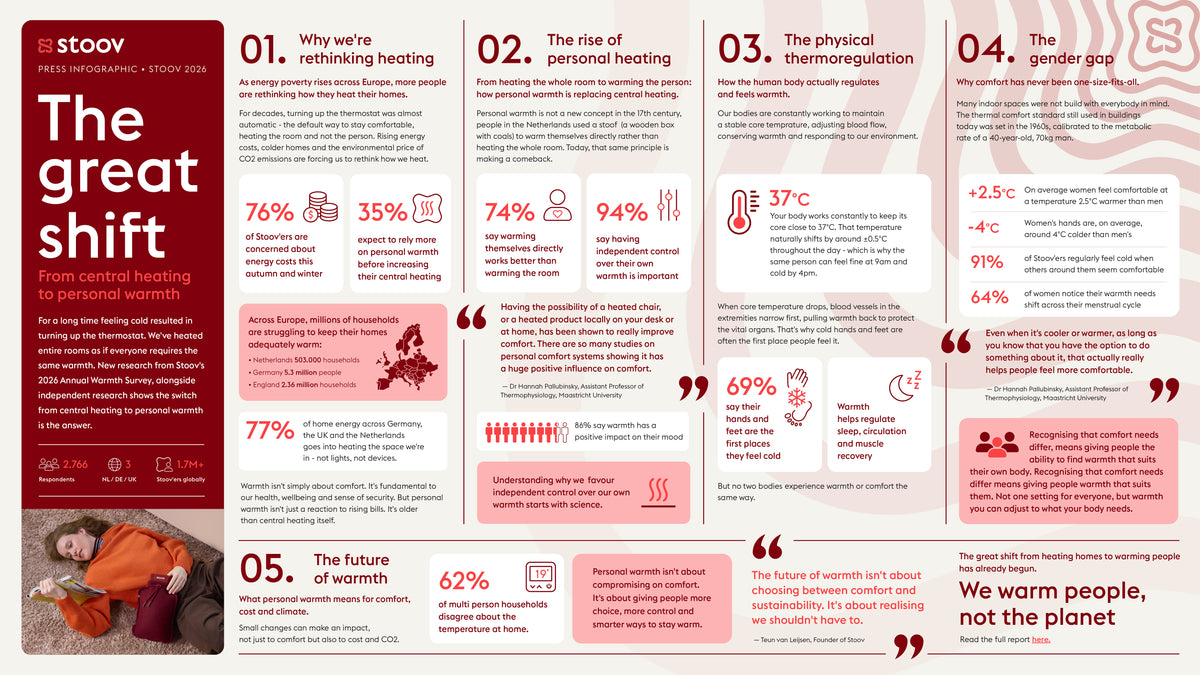
Together with experts, existing scientific research and 2,766 people across the Netherlands, Germany and the UK, we explored how we experience warmth, what makes us comfortable and why personal control matters.
Here’s what we discovered.

2. From central heating to personal warmth
91% regularly feel cold in spaces where others feel comfortable.
One person reaches for a jumper. Another opens a window. Neither is wrong. Different bodies simply experience the same temperature differently.
Our bodies regulate temperature constantly, and factors from physiology to time of day can influence how warm or cold we feel.
Comfort isn’t simply about the number on the thermostat.
3. The science behind the shift
69% say their hands and feet are the first places they feel cold.
Our bodies work hard to maintain a core temperature of around 37°C, while the temperature of our skin and extremities can vary much more.
It helps explain something most of us already know instinctively: sometimes you don’t need the whole room to feel warmer.
You just want warmth where you feel it most.

4. Comfort isn’t one size fits all
94% say having independent control over their own warmth is important.
And 74% say warming themselves directly works better for them than warming the room.
Dr Hannah Pallubinsky, Assistant Professor of Thermophysiology at Maastricht University, points to local warming and cooling as a promising way to manage individual comfort and potentially reduce energy use. Having control can itself play a role in how comfortable we feel.
Your warmth. Your moment. Your way.

5. The future of warmth
There’s another side to personal comfort that’s often overlooked: we don’t all experience warmth equally.
Research referenced in our report shows that, on average, women are comfortable at temperatures around 2.5°C warmer than men, while women’s hands can be around 4°C colder.
Our own research also found that 64% of women notice changes in how they experience warmth and cold during their menstrual cycle.
So when one person reaches for the thermostat while another insists the room is warm enough, it might not simply be a matter of preference.
Different bodies can experience the same room differently.
Personal warmth isn’t new. Long before central heating, Dutch households used a stoof to warm the person, not the whole room.
Technology has changed. The principle hasn’t.
Today, more than 1.8 million Stoov’ers are part of that shift.
Comfort is personal. So the future of warmth should be too.
Not heating more. Warming better.
We warm people, not the planet.
Sources & methodology
The Science of Warmth Report 2026 combines findings from Stoov’s Annual Warmth Survey among 2,766 respondents in the Netherlands, Germany and the UK, interviews with Dr Hannah Pallubinsky, Assistant Professor of Thermophysiology at Maastricht University, and findings from independent scientific research. Survey findings are based on self-reported responses and should be interpreted as such.